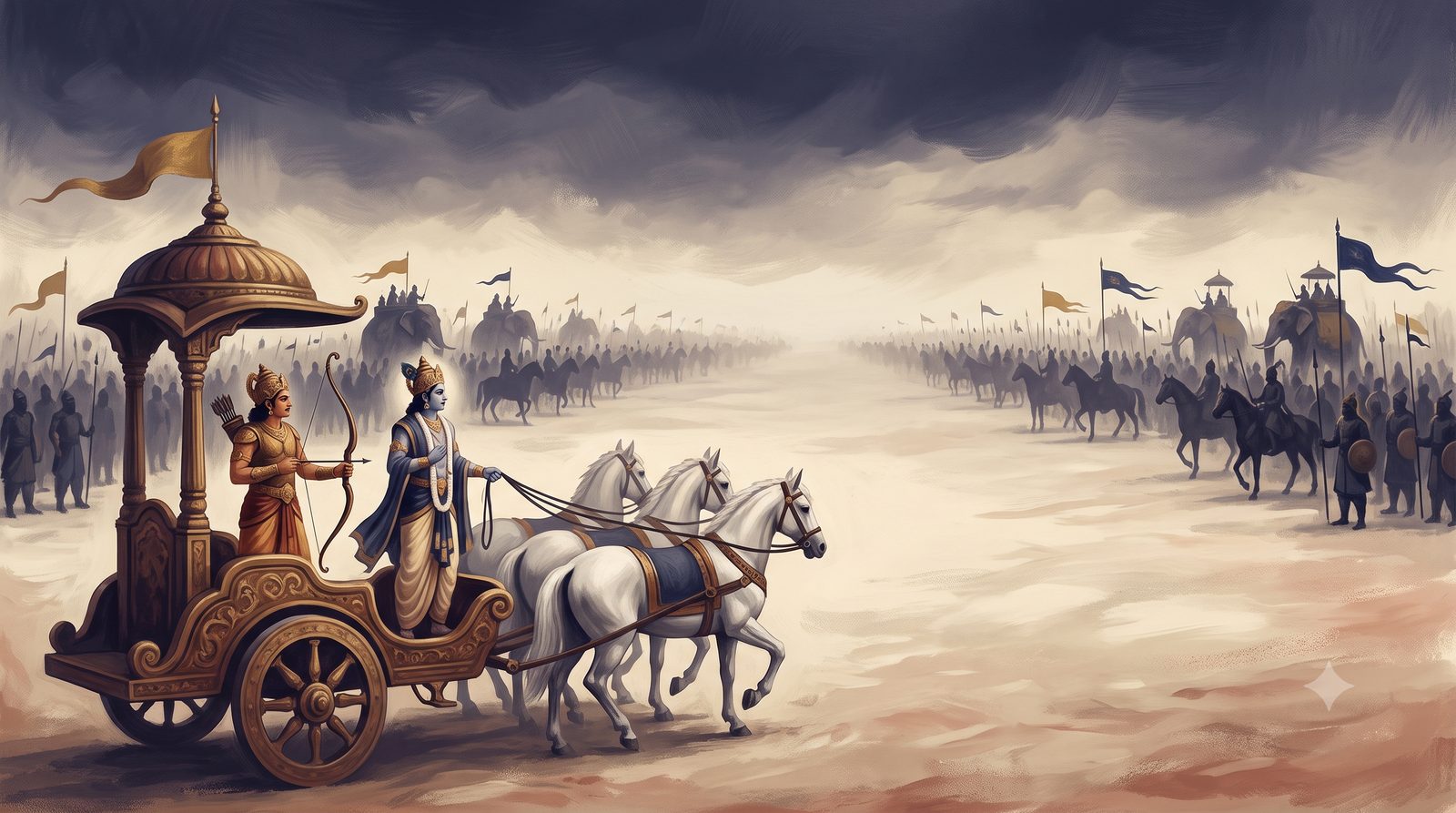
The Gita starts on the worst possible day
Most books begin at the beginning. The Bhagavad Gita begins at the end of something — on the eighteenth morning of a standoff, with two armies facing each other across a field called Kurukshetra, and a blind king asking his charioteer what is happening out there.
If you open the Gita cold, this is disorienting. Names arrive in volleys. Somebody blows a conch. A warrior called Arjuna asks to be driven into the gap between the armies, looks across at the other side, and then does something no epic hero is supposed to do: he sits down and says he will not fight.
To understand why that moment matters, you need to know who is standing opposite him. And for that, you need to go back about forty years.
Two sets of cousins, one throne
The kingdom of Hastinapura had a succession problem. The elder of two brothers, Dhritarashtra, was born blind, and by the custom of the time that ruled him out of kingship. So the younger brother, Pandu, took the throne instead.
Pandu died young. His five sons — the Pandavas — were still children. Dhritarashtra stepped in to rule until they came of age, and raised them alongside his own hundred sons, the Kauravas, the eldest of whom was Duryodhana.
So you have two sets of cousins growing up in the same palace, both with a claim, one set holding the throne and the other set waiting for it. Duryodhana grew up watching boys he considered outsiders being groomed to take what he thought was his. The Pandavas grew up knowing the crown was theirs and that the man sitting on it had no intention of handing it over.
Nobody in this story is a stranger to anyone else. That is the whole point, and it becomes unbearable in about two hours of story time.
The dice game
The Pandavas were eventually given their own territory, built a capital, and did well — well enough that Duryodhana's resentment curdled into something more active. His uncle Shakuni proposed a solution that required no army at all.
They invited Yudhishthira, the eldest Pandava, to a game of dice. He had a weakness for the game and a code of honour that made refusing an invitation impossible. Shakuni played with loaded dice.
Yudhishthira lost his wealth. Then his kingdom. Then his brothers. Then himself. Then, having nothing left, he staked and lost Draupadi — the wife shared by all five brothers — and she was dragged into the assembly hall in front of the entire court.
What happened next is the wound the war grows out of. Duryodhana's brother Dushasana attempted to disrobe her in open court. Bhishma, the family patriarch, said nothing. Drona, the teacher, said nothing. Dhritarashtra, the king, said nothing until it was far too late.
Draupadi asked the assembly a question that nobody could answer: if Yudhishthira had already lost himself, by what right did he then stake her? No one in that hall had a reply. They looked at the floor instead.
Every man in that room outranked the moment. Not one of them met it.
Thirteen years, and then a request for five villages
The settlement was exile: twelve years in the forest, and a thirteenth spent in disguise. If they were recognised during that final year, the whole term would start again. The Pandavas served it. All of it.
They came back and asked for their kingdom. Duryodhana refused.
Krishna went as an envoy to negotiate, and the ask was reduced, and reduced again, until the Pandavas were requesting five villages — one for each brother. Not the throne. Not the capital. Five villages.
Duryodhana's answer is the sentence the whole war rests on: he would not part with land enough to fit the point of a needle.
That is when the armies were called.
Why Arjuna breaks
Now go back to that field. Arjuna asks Krishna to drive him into the space between the two armies so he can see who has assembled to fight.
He looks across, and the problem with the whole enterprise arrives at once. The commander of the opposing army is Bhishma, the great-uncle who raised him. Beside him is Drona, the teacher who taught him archery and loved him best of all his students. Beyond them are cousins he grew up with, uncles, fathers-in-law, boys who had been at his wedding.
This is not an army. It is a family reunion with weapons.
Arjuna's bow slips from his hand. He tells Krishna he cannot see any good coming from killing his own people, that he would rather be killed unarmed than win a kingdom over their bodies. And then he sits down in the chariot and stops.
The Bhagavad Gita is what Krishna says to him next. Seven hundred verses, spoken in the gap between two armies, to one man who has decided he cannot do the thing he came to do.
You are not reading a book about war. You are reading a very long conversation about what to do when every available choice is a bad one — which is a considerably more useful thing to have on hand.
The Gita is a conversation between two people standing in the gap between two armies, and one of them has just refused to fight. Everything Krishna says is an answer to that refusal.