The sleeping man and the two cousins
The thirteen years are over. The Pandavas want their kingdom back. Duryodhana says no, and both sides begin shopping for allies.
Arjuna and Duryodhana arrive at Dwarka on the same errand within the same hour. Krishna is asleep.
Duryodhana takes the seat at his head. Arjuna waits at his feet. Krishna wakes and, naturally, sees Arjuna first.
Duryodhana objects that he arrived first. Krishna, with the straightest face in world literature, agrees that he did — but says he saw Arjuna first, and Arjuna is the younger, so Arjuna chooses. On one side: the entire Narayani army, every soldier Krishna has. On the other: Krishna himself, alone, unarmed, and under a personal vow not to raise a weapon for the length of the war.
Arjuna takes the unarmed man without hesitating.
Duryodhana leaves delighted. He has acquired an army and, as he sees it, outmanoeuvred his cousin by a wide margin.
Duryodhana walks out of that room genuinely pleased with himself. The entire war is in that detail.
The ask gets smaller
Sanjaya goes first, carrying a message from Dhritarashtra that is mostly an elegant way of not answering the question.
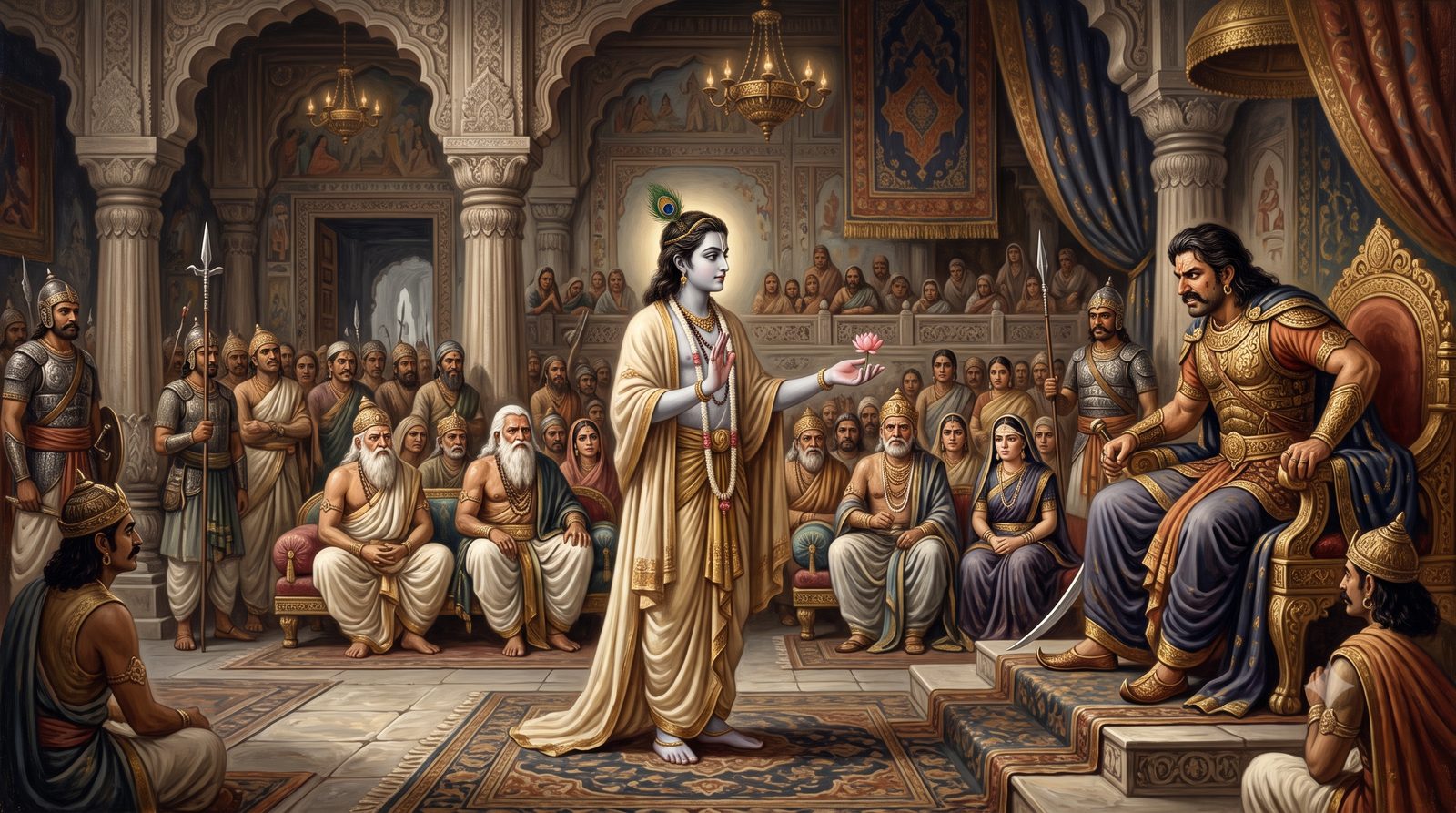
Then Krishna goes himself, as the Pandavas' ambassador, into the court at Hastinapura.
The original claim is half the kingdom — Indraprastha, the city the Pandavas built out of a forest with their own hands and lost at dice.
Yudhishthira reduces it before Krishna leaves. Five villages. Avisthala, Vrikasthala, Makandi, Varanavata, and any fifth they care to name. Five villages for five brothers. Give us that and there is no war.
This is a smaller settlement than almost anyone on the Pandava side thinks they should accept. Bhima is furious about it. Draupadi is furious about it; she has been waiting thirteen years with her hair deliberately unbound.
Duryodhana's reply is the most famous refusal in Indian literature. He will not give them land enough to be covered by the point of a needle. Not without a fight.
Everyone in the room tells him no
Bhishma tells him to accept. Drona tells him to accept. Vidura tells him to accept, at length and without diplomacy. Even Dhritarashtra, in private, knows exactly what is coming.
Gandhari is sent for. She tells her son, with the authority of a woman who blindfolded herself for life out of solidarity with her husband, that a kingdom held against dharma does not stay held.
Duryodhana walks out of the court.
Then he comes back with the idea of having Krishna arrested, which goes about as well as anyone would expect. Krishna shows the assembly the universal form — every world, every god, every living thing, all of it at once, in one body — and Dhritarashtra is briefly given sight so that he can see it. Having seen it, he asks to be made blind again, because there is nothing left he wishes to look at.
Krishna leaves. On his way out he takes Karna aside in his chariot and tells him who his mother is, which is a separate catastrophe entirely.
The single most powerful being in the story spent that whole day asking politely for five villages. He had the alternative in his pocket the entire time and did not reach for it.
The failure is not really Duryodhana's
Duryodhana is the one who refuses, and he is not a sympathetic man. But he has been refusing things for sixty years and nobody has ever stopped him once.
Dhritarashtra could have overruled him at any point in any of those decades. At the lac house. At the dice game, twice in one night. Here, in his own court, with Bhishma and Drona and Vidura and Gandhari all lined up on the same side of the argument.
He doesn't. Not because he disagrees with them — he knows precisely what is about to happen; the whole Bhagavad Gita reaches him second-hand through Sanjaya because he cannot bring himself to be on the field — but because telling his son no is the one thing he has never managed in his life.
Vidura says the quiet part aloud: the dynasty will end because one man could not restrain one boy.
Wars are rarely started by the people who want them. They are finished off by the people who could have said no and found a reason not to.
What this has to do with the Gita
Here is the part worth carrying into Chapter 1.
Arjuna's breakdown at the start of the Bhagavad Gita only makes sense if you know that this war was avoidable, that it was very nearly avoided, and that the last offer on the table was five villages.
He is not standing between two armies because nobody tried diplomacy. He is standing there because diplomacy was tried carefully, repeatedly, and by the best negotiator alive — and a man in a hall said no on a point of pride, while his entire family begged him to reconsider.
So when Arjuna puts the bow down in the first chapter and says he would rather be killed unarmed and unresisting than go through with this, he is not being a coward. He is the last person on that field still behaving as though the negotiation is open.
Krishna's answer to that takes seven hundred verses.
Krishna went to Hastinapura as the Pandavas' ambassador and asked for five villages instead of half a kingdom. Duryodhana refused to part with enough land to cover the point of a needle, against the advice of Bhishma, Drona, Vidura and his own mother — and his father, who could have overruled him at any moment, didn't.