A lecture delivered to a pregnant woman
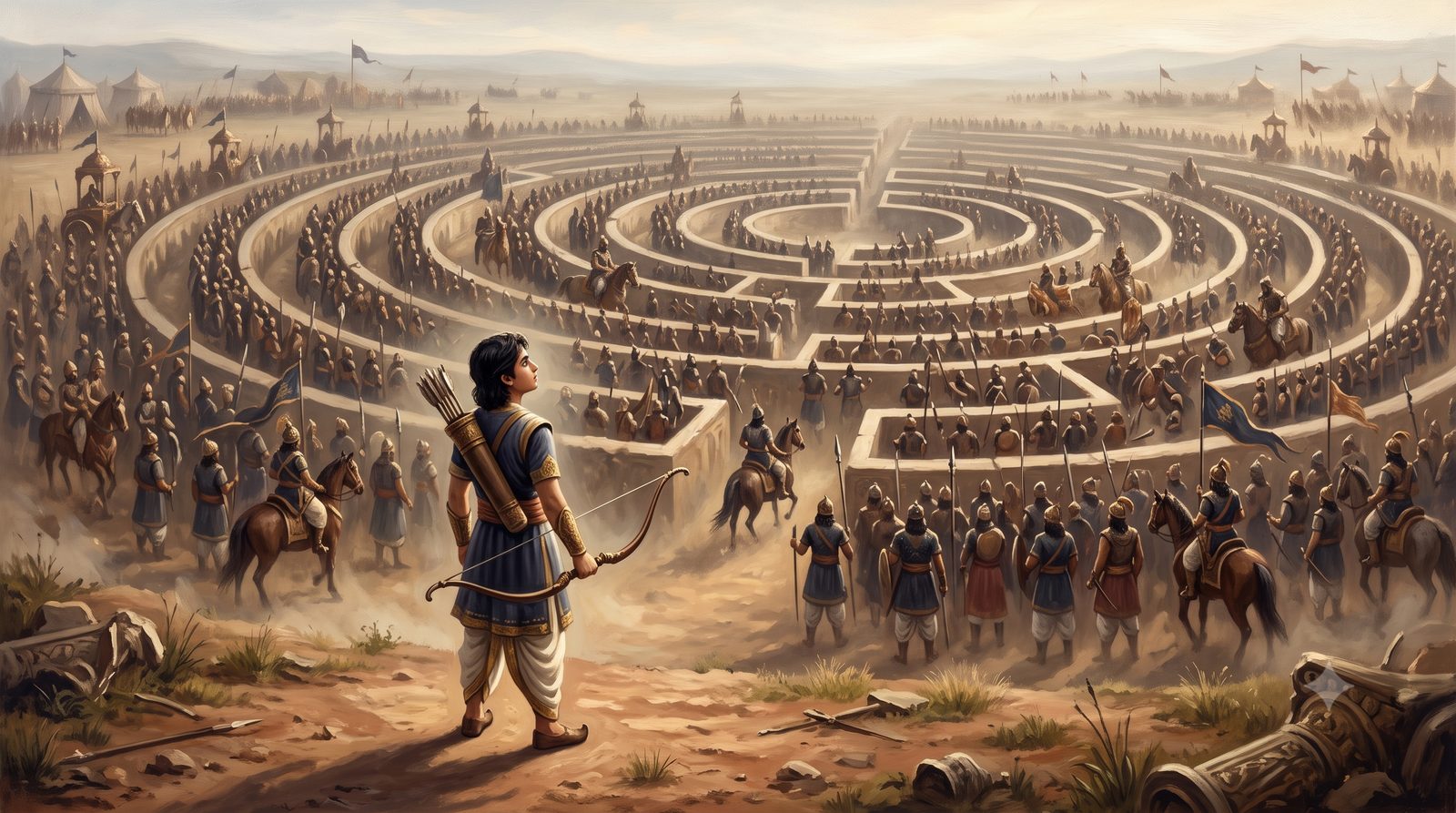
Arjuna was married to Subhadra, Krishna's sister. While she was pregnant, he was explaining to her how to penetrate the chakravyuha — a spiral military formation, rotating, layered, extremely difficult to break into and considerably harder to leave.
It is an odd thing to be discussing with your wife of an evening, but this is a family in which everyone is a professional soldier.
The child in the womb was listening. He absorbed the entry technique completely — every layer, every rotation, exactly where to strike.
Then Subhadra, who had been listening to a detailed technical lecture on military formations for some time, fell asleep.
Arjuna stopped talking. The explanation of how to get out was never given.
As setups go, it is almost unbearably neat.
Sixteen years later
Day thirteen of the war. Drona, commanding the Kaurava forces, deploys the chakravyuha specifically because he knows only a handful of people on the other side can break it — and Arjuna, the most reliable of them, has been drawn away to a different part of the field.
The Pandava army is stuck. The formation is grinding forward and nobody can get inside it.
Abhimanyu, sixteen years old, tells his uncles that he can open it. He is entirely honest about the limitation: he can get in, he does not know how to get out.
The plan is straightforward. He breaks the formation, the others follow him in through the gap, and they fight their way out together.
He goes in. The gap closes behind him.
Jayadratha holds the entrance and the rest of the Pandava force cannot follow. Abhimanyu is inside, alone, in a rotating formation he does not know how to leave.
He told them exactly what he could and could not do. They sent him anyway.
What happens inside
He fights extraordinarily well. That is not sentiment — the text spends real time on it, and it is the reason the scene lands. This is a boy doing genuinely remarkable things while entirely alone.
So they change the rules.
The conventions of that war were specific: single combat, no attacking an opponent from behind, no striking someone whose weapon is gone. On day thirteen, inside that formation, the most senior warriors of the Kaurava army — Drona, Karna, Kripa, Ashwatthama, Duryodhana's son among them — surround one sixteen-year-old and attack together.
His bow is cut. His chariot is destroyed. He fights with a wheel from it.
They kill him from all sides at once.
This is the moment the war stops pretending to be honourable. Everything afterwards — Arjuna's terrible vow to kill Jayadratha before sunset the following day, the night fighting, Krishna listing the Kauravas' broken conventions back at Karna in the final battle — traces to this afternoon.
The part that stays with you
The story is usually told as one about incomplete knowledge, and it works at that level. Knowing how to start something is not the same as knowing how to finish it, and the gap between those two is where people get hurt.
But there is a harder reading available.
Abhimanyu did not overestimate himself. He stated his limitation plainly and in advance, to experienced commanders who understood exactly what he was telling them. They accepted the risk on his behalf because the formation had to be broken and he was the only one there who could do it.
The failure was not his half-lesson. It was everyone else's plan to cover for it.
Which is a more uncomfortable story, and a more recognisable one. Most people who get in over their head were reasonably clear about their own limits. Somebody more senior decided it would probably be fine.
Abhimanyu heard how to enter the chakravyuha from inside the womb, and never heard how to leave because his mother fell asleep. Sixteen years later he said so plainly, and was sent in anyway.