A teenage girl with a dangerous mantra
Kunti, as a young girl, is given the job of looking after the sage Durvasa, who is famous throughout Indian literature for being impossible to look after. She manages it without once irritating him, which may be the single most impressive feat in the epic.
He rewards her with a mantra. Say it, name a god, and the god arrives and gives you a son.
This is an alarming thing to hand a teenager, and the text is fully aware of it.
She tries it out. On the sun. To see whether it works.
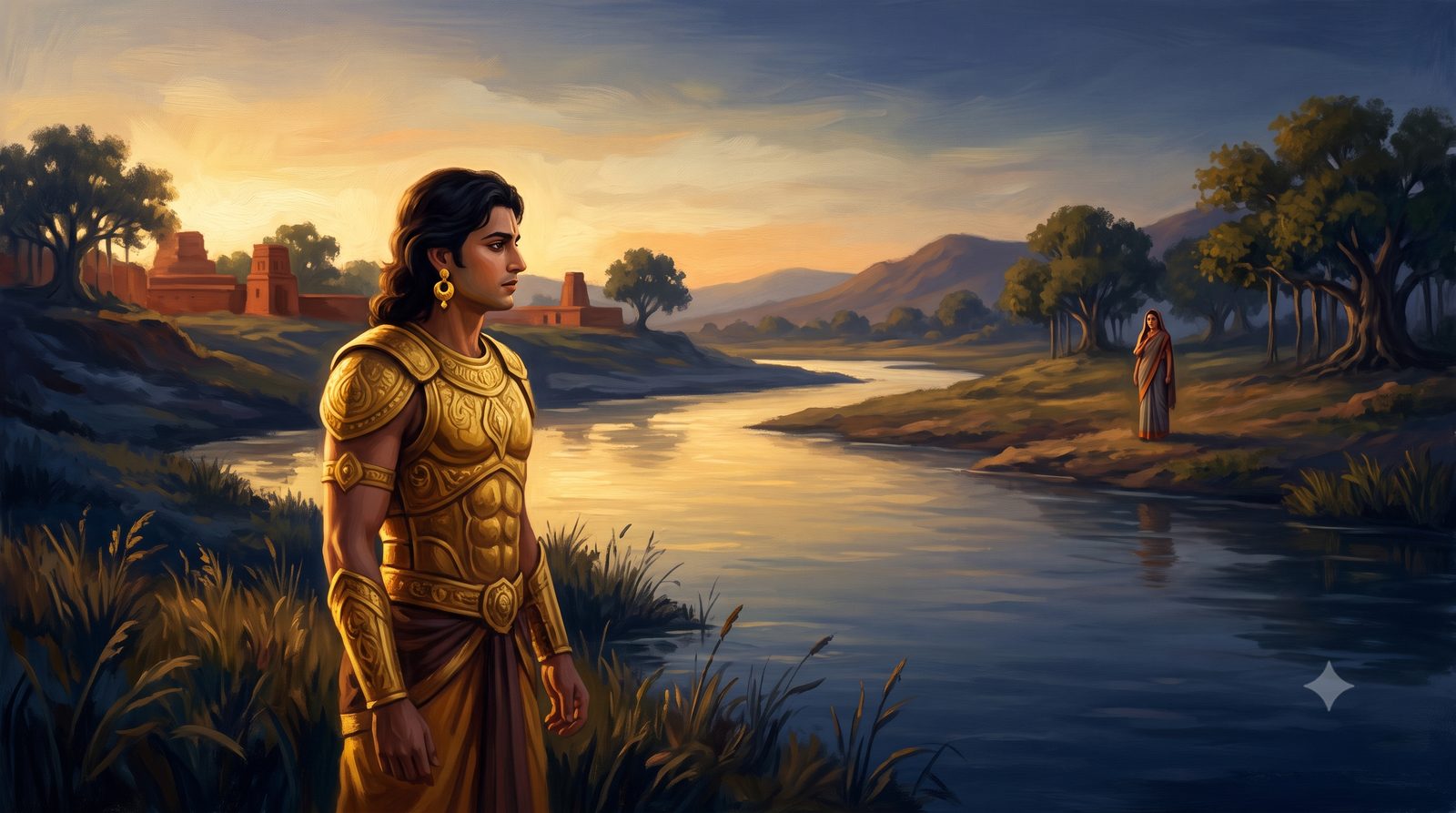
It works. Surya arrives. She panics and asks him to go away again, and he explains that the mantra is binding and the matter is already settled — a scene that reads today exactly as badly as it sounds. She gets a son, born wearing golden armour fused to his skin and earrings that cannot be removed, which makes him more or less unkillable.
She is unmarried and about sixteen. She puts him in a basket and sets him on the river.
The first thing anybody ever does for Karna is abandon him. It rather sets the tone.
Raised by the man who drove the chariots
The basket is found by Adhiratha, a suta — a charioteer — and his wife Radha. They raise him as their own. He is Radheya: Radha's boy. In a lifetime of being insulted for it, he never once disowns them, which is worth holding on to.
He wants to be an archer. Drona takes royal students. Karna is not royal.
So he goes to Parashurama and says he is a brahmin — true in the sense that it gets him through the door and false in every other sense. Parashurama teaches him everything, including the brahmastra.
Then the scene everyone remembers. Parashurama falls asleep with his head in Karna's lap. An insect bores into Karna's thigh. Karna does not move, because moving would wake his teacher. The blood reaches Parashurama, who wakes up and does the arithmetic instantly: no brahmin sits through that. Only a kshatriya does.
The curse: the knowledge will desert you at the moment you most need it.
Which is about as cruel as the universe gets, because the thing that exposed him was not the lie. It was the quality the lie was told to protect.
A tournament, a laugh, and a kingdom
The exhibition at Hastinapura. Arjuna has just been presented to the city as the finest archer alive. Karna walks into the arena and matches everything Arjuna has done, item by item, which is not how these events are supposed to go.
Before any duel can happen, Kripa does the correct and proper thing and asks for his lineage, because a prince cannot be made to fight a nobody.
The hall laughs.
Duryodhana stands up and makes him King of Anga on the spot, in front of everyone, immediately.
You could build an entire reading of the Mahabharata on that one gesture. It is a real act of generosity and a piece of cold political recruitment at the same moment, and Duryodhana is not remotely confused about which. Karna is bought in public. He knows it. He does not care, because nobody else in that hall offered him anything at all.
Then Adhiratha pushes through the crowd to embrace his newly crowned son, in front of the entire court, and Bhima says something about a charioteer's boy not being worth the arrows.
Duryodhana handed him a crown in a room where everyone else handed him a laugh. That debt is never paid off, and Karna never once tries to renegotiate it.
The worst briefing in history
Thirteen years later Krishna goes to Hastinapura to prevent the war, fails, and on the way out invites Karna into his chariot for a quiet word.
He tells him everything. You are Kunti's son. You were born before she married. Yudhishthira is your younger brother. By birth you are the eldest of them, which does not merely make you a Pandava — it makes you the heir, with a better claim than anyone currently arguing about it.
Then the offer. Come with us. You will be crowned. The Pandavas will touch your feet. Draupadi will be your wife. It is in the Udyoga Parva and it is as transactional as it sounds.
Karna's reply is the finest speech in the book. Radha is my mother; she fed me and raised me and the funeral rites are hers. Adhiratha is my father. Duryodhana has leaned on me for thirteen years on the understanding that I would be there, and I am not going to walk out on him now in exchange for a throne.
Then he asks Krishna to keep it quiet — specifically from Yudhishthira. Because if Yudhishthira found out, he would hand over the kingdom on the spot, and Karna would hand it straight to Duryodhana, and the entire exercise would have been pointless.
Kunti comes to him herself the next morning on the riverbank. He is not warm. He points out, accurately, that she threw him away, then stayed silent through every humiliation he has ever suffered, and has arrived now, on the eve of a war, because there is finally something she needs.
And then he gives her what she came for anyway. He will not kill any of her sons except Arjuna. Either way, he says, you will still have five.
Indra — Arjuna's father — had already come to Karna disguised as a beggar and asked for the armour he was born in, knowing it made him unkillable. Surya warned him it was a trick. Karna gave it away anyway, because he had never refused a request made at midday and did not intend to start.
Why this story will not leave anyone alone
Karna is the most argued-about character in the epic and it is not close.
He is also on the wrong side, and the text does not soften it. He is in the hall at the dice game and says nothing useful; he speaks cruelly to Draupadi; he is one of the warriors who surround a sixteen-year-old boy on the thirteenth day and kill him from every direction at once. He is not a secret hero who got bad press.
But everything that made him available to Duryodhana was done to him by people who then held it against him. Kunti put him in the river. Drona turned him away. Kripa asked for his pedigree in a full hall. Parashurama cursed him for a lie he only told because the door was shut.
And the one piece of information that would have changed his whole life arrives as a recruitment pitch, delivered by the cleverest man alive, at the last moment it could possibly be useful to the person delivering it.
Nobody withheld it out of malice. Everybody withheld it because mentioning it was inconvenient at the time. That is how most secrets actually work.
He dies on the seventeenth day with his chariot wheel sunk in the earth and the brahmastra gone from his memory, exactly as promised, asking for a pause under rules of engagement he had himself helped to ignore four days earlier, when the boy in the formation asked for the same thing.
Karna was Kunti's firstborn, conceived by the sun god before her marriage and set adrift on a river. Raised by a charioteer, refused by teachers, humiliated in public and rescued only by Duryodhana, he learned the truth about himself from Krishna days before the war — and chose to stay with the man who had taken him in when nobody else would.