The application is rejected
Drona is the archery instructor to the Kuru princes. It is a salaried royal appointment, and he has made specific personal promises to his employer's sons — most relevantly to Arjuna, who has been told he will be the finest archer in the world.
Eklavya is the son of Hiranyadhanu, chief of the Nishadas, a forest people. He comes to Drona and asks to be taught.
Drona says no. The text gives the refusal without much elaboration. Later tradition and modern readings argue hard about the reason — his obligation to the royal house, the boy's birth, or both at once. What nobody argues about is the sentence itself. He refuses.
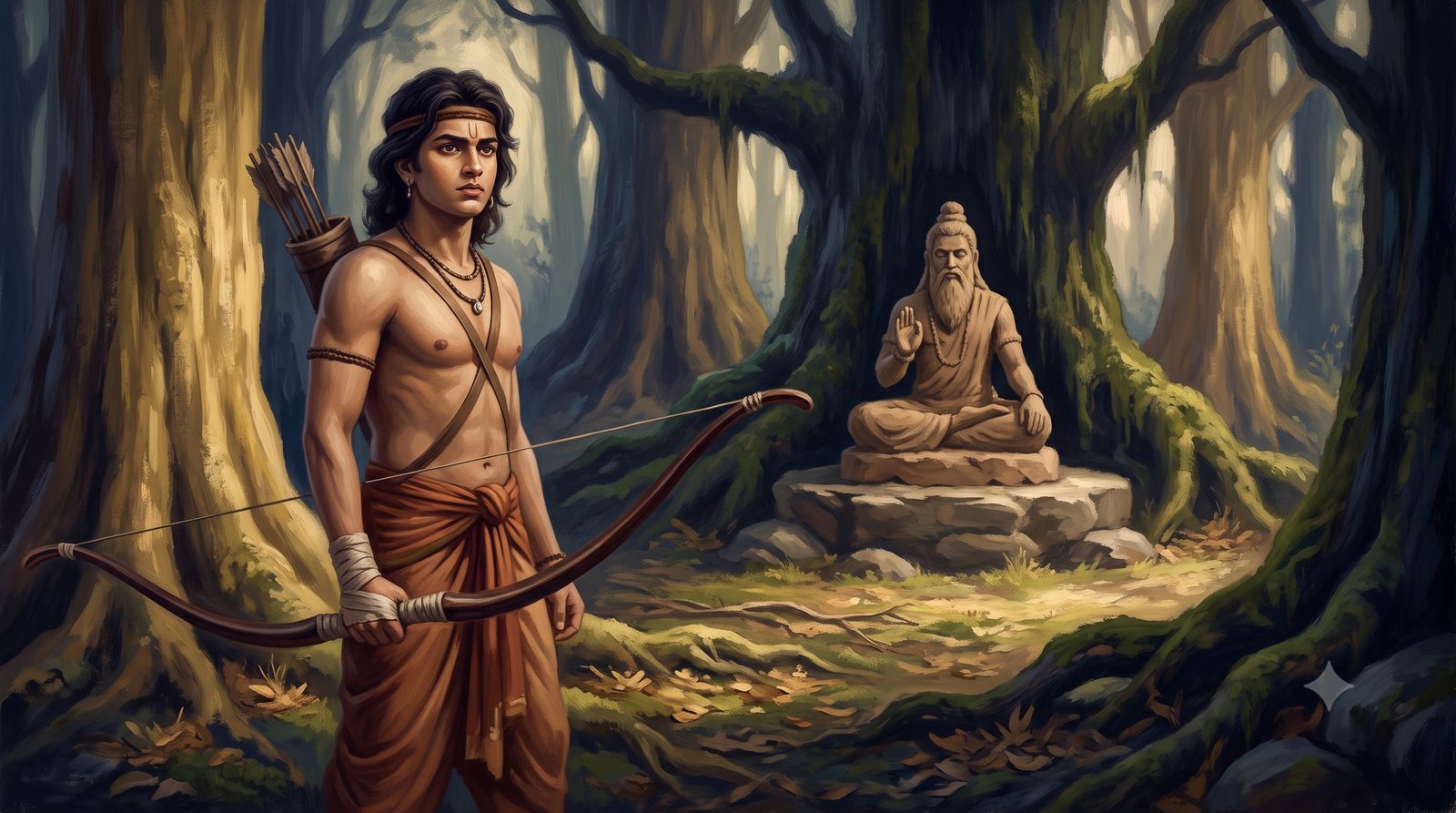
Eklavya touches his feet, goes back into the forest, and then does something nobody has asked him to do. He builds a clay image of Drona, installs it properly, and begins training in front of it.
He is not pretending Drona taught him. He is appointing Drona as his teacher unilaterally, in absentia, with no consent required — which is possibly the single most audacious act in the Mahabharata.
The dog, again
The princes are out hunting. A dog belonging to the party gets ahead of them and starts barking at something in the trees.
It comes back with seven arrows in its mouth. Not through it — in it. The dog is entirely unhurt. It simply cannot bark.
This is a flex of such ridiculous precision that the hunt is abandoned on the spot and the whole party goes looking for whoever did it.
They find a boy covered in dirt, hair matted, shooting faster than any of them can follow. Asked who he is, he introduces himself cheerfully as a student of Drona.
Arjuna goes straight back to his teacher in something close to distress. You told me nobody would surpass me.
Which tells you a certain amount about Arjuna, and the epic lets it sit there without comment.
The fee
Drona goes to the forest. Eklavya sees him coming and throws himself at his feet.
Drona asks whether he is really his student. Eklavya says yes, obviously, and shows him the clay figure he has been bowing to every morning for years.
Then Drona says: in that case, there is a gurudakshina owing. A teacher's fee.
And Eklavya says: anything. He says it happily. This is the part people skip past and it is the part that actually matters — he is not cornered, he is not frightened, he is delighted. Somebody has finally acknowledged him.
Drona asks for his right thumb.
Eklavya cuts it off and hands it over, and the text notes that his face did not change.
He is not robbed. He pays, gladly, a fee that was never owed, for a service that was never provided.
He can still shoot afterwards. Not as he did. Arjuna's position is secure.
What the story is actually doing
The straightforward reading is that this is a story about caste, and that reading is available and not wrong. A forest boy is denied an education, excels anyway, and is mutilated for it by the man who refused him.
The harder reading is that Drona never breaks a single rule.
He is honouring a commitment made to someone with standing, and he finds a technically impeccable mechanism for doing it. If Eklavya claims him as his teacher, then a fee is due; the fee is the teacher's to name; it is paid freely and in full. The logic is airtight at every joint. That is exactly what makes it horrifying — nothing here needs a villain, only a procedure and a man who benefits from it.
And nobody objects. Not one prince in that hunting party says a word. Arjuna, who will later spend an entire chapter of the Bhagavad Gita unable to lift his bow against people he is formally at war with, has nothing to say about this at all.
Eklavya does not get a redemption arc either. He grows up, becomes a king, ends up on Jarasandha's side, and is killed by Krishna — a fact mentioned later almost in passing, the way you would note a settled account. The boy who gave his thumb gets one line.
It is a very old story and an extremely current one. Somebody learns the thing without being allowed into the room, gets good at it, and is then asked to produce credentials by the institution that would not let them in.
Drona refused to teach Eklavya, so Eklavya built a clay image of him and trained in front of it until he outshot Arjuna. Drona then claimed him as a student purely in order to demand a teacher's fee — Eklavya's right thumb — and Eklavya paid it without hesitation, which is the part worth losing sleep over.