A wet prince and a laugh
The Pandavas have Indraprastha, a city they built out of a forest, with a hall designed by Maya the architect and full of optical tricks — floors that look like water, water that looks like floor.
Duryodhana visits. He mistakes a polished crystal floor for a pool and lifts his clothes to wade across it. Then, having learned his lesson, he strides confidently into an actual pool and falls in.
He is laughed at. He goes home and tells Shakuni he would rather be dead.
Shakuni, his uncle, Gandhari's brother, and a man with an unnatural relationship with dice, has a better idea than dying.
The famous taunt — the blind man's son is also blind — is not in Vyasa's text. It comes from later retellings, most memorably the 1988 television series. It is a magnificent line and it is not scripture. What the epic actually describes is a hall of people laughing at a soaking wet prince, which is arguably worse, because there is nothing specific to be angry about.
The invitation nobody could refuse
Dhritarashtra agrees to host a friendly game. Vidura objects in the plainest terms available — this will finish the dynasty — and is told to be quiet.
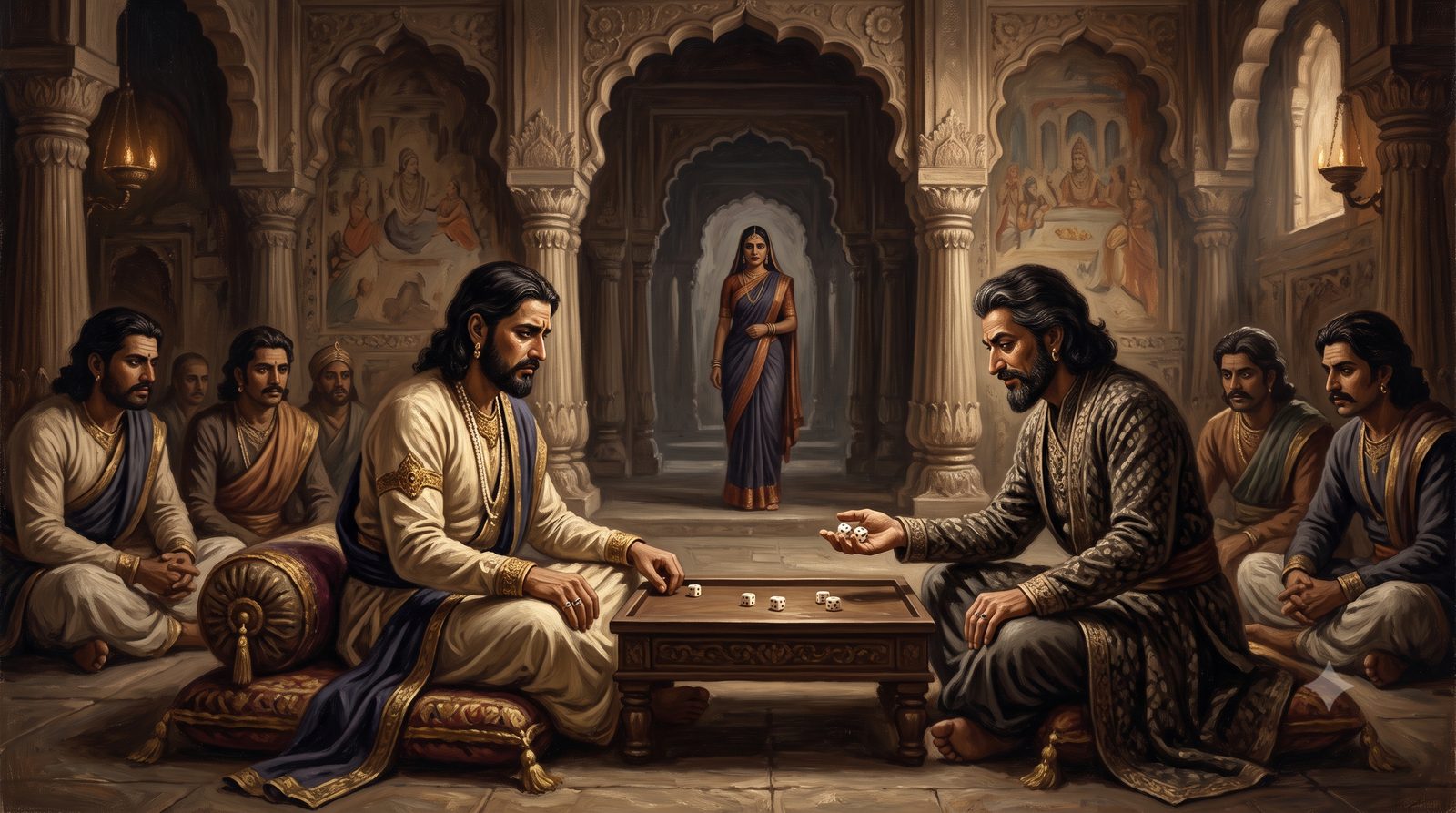
Yudhishthira comes because he has been invited by his uncle, and because a kshatriya who is challenged to a game does not decline. He says this out loud. He walks in knowing it is a trap and knowing the rules do not permit him to turn round.
Shakuni plays on Duryodhana's behalf. Yudhishthira objects that this is irregular — a proxy is not a player. He is told it is permitted. He plays anyway.
He loses pearls. Then gold. Then chariots, horses, elephants, servants, the army, the treasury, the city, the kingdom.
Then his brothers, staked individually and in ascending order of usefulness — Nakula, then Sahadeva, then Arjuna, then Bhima — which is its own quiet insult, administered by their eldest brother in public.
Then himself.
Then Shakuni observes, gently, that there is one thing left.
It is worth being clear about what is happening here, because the story is usually told as though Yudhishthira were under a spell. He is not. He is a grown man in a full court, losing badly to a known cheat, and raising his stakes each time because the next throw will surely put it right. There is no supernatural compulsion anywhere in the text. There is only a man who cannot make himself stand up and leave.
The question nobody answers
Draupadi is in her apartments. She is menstruating and wearing a single garment.
Dushasana goes and drags her into the hall by the hair.
And she asks one question. Not a plea — a point of law. Did my husband lose himself before he staked me? Because if he was already a slave when he wagered me, he was not a free man, and a man who owns nothing cannot stake anything.
It is a genuinely excellent argument. It may be the best argument anyone makes in the entire Mahabharata, and it is made by the only person in the room with no standing to make it.
The hall contains Bhishma, Drona, Kripa, Vidura, Dhritarashtra and the assembled Kuru court. These are the most respected living authorities on dharma on the subcontinent.
Bhishma's answer, in effect: the question is subtle, and I cannot resolve it.
The miracle everyone knows — the cloth that never runs out — does not appear in the oldest manuscript tradition. In the critical edition Draupadi is protected without it. The miracle was added later, and you can see why: without it, the scene is a full royal court watching an assault and discussing procedure.
Not one man in that hall says no. Several of them observe that the matter is complicated, which is what men say in rooms like that.
Vikarna, one of Duryodhana's hundred brothers and a complete nobody in the story until this moment, is the only person who speaks up for her. He is shouted down by Karna.
Then comes the disrobing, and Duryodhana baring his thigh and inviting Draupadi to sit on it — the gesture that produces Bhima's two vows: to break that thigh, and to drink Dushasana's blood. Both are kept, thirteen years later, in considerable detail.
Nobody in that hall believes a word of what is being said. Dhritarashtra can hear it all. Bhishma, who raised these boys, is sitting there. The silence is not confusion. It is a room full of senior men calculating, correctly, that the cost of objecting is higher than the cost of watching.
Two boons and one more throw
Jackals howl outside. Omens pile up. Dhritarashtra, who has sat through the entire evening, is finally frightened into acting — not by conscience but by superstition, which is a distinction the epic is careful to preserve.
He offers Draupadi boons. She asks for Yudhishthira's freedom. Then for her other husbands'. Offered a third, she declines it, saying a kshatriya woman may ask for two and no more.
Everything is returned. The Pandavas leave.
And then Duryodhana persuades his father to call them back for one more throw. A single game. The stake: twelve years in exile and a thirteenth in disguise, and if they are discovered in that final year, another twelve.
Yudhishthira comes back. He plays. He loses.
That is the detail worth sitting with. He had got out. He was on the road home with his kingdom restored and his family intact. He turned round, walked back in, and did it again.
Where the war actually starts
People date the war to Krishna's failed embassy, or to Duryodhana's refusal to part with five villages. Both are reasonable answers.
The honest answer is this room. Everything after it is consequence. Draupadi's unbound hair, which she refuses to tie until it can be washed in Dushasana's blood. Bhima's vows. Thirteen years of a family with nothing to do but think about one evening.
And Yudhishthira — the dharma king, the man who will one day refuse heaven itself rather than abandon a stray dog — is the one who did it.
The Mahabharata is not very interested in good people and bad people. It is interested in what good people do when they are losing and cannot make themselves stop.
Humiliated at Indraprastha, Duryodhana had his uncle Shakuni lure Yudhishthira into a rigged dice game. Yudhishthira lost his wealth, his kingdom, his brothers, himself and finally Draupadi — and when she asked the court whether a man who had already lost himself could legally stake her, the most respected men in the world said the question was too difficult.