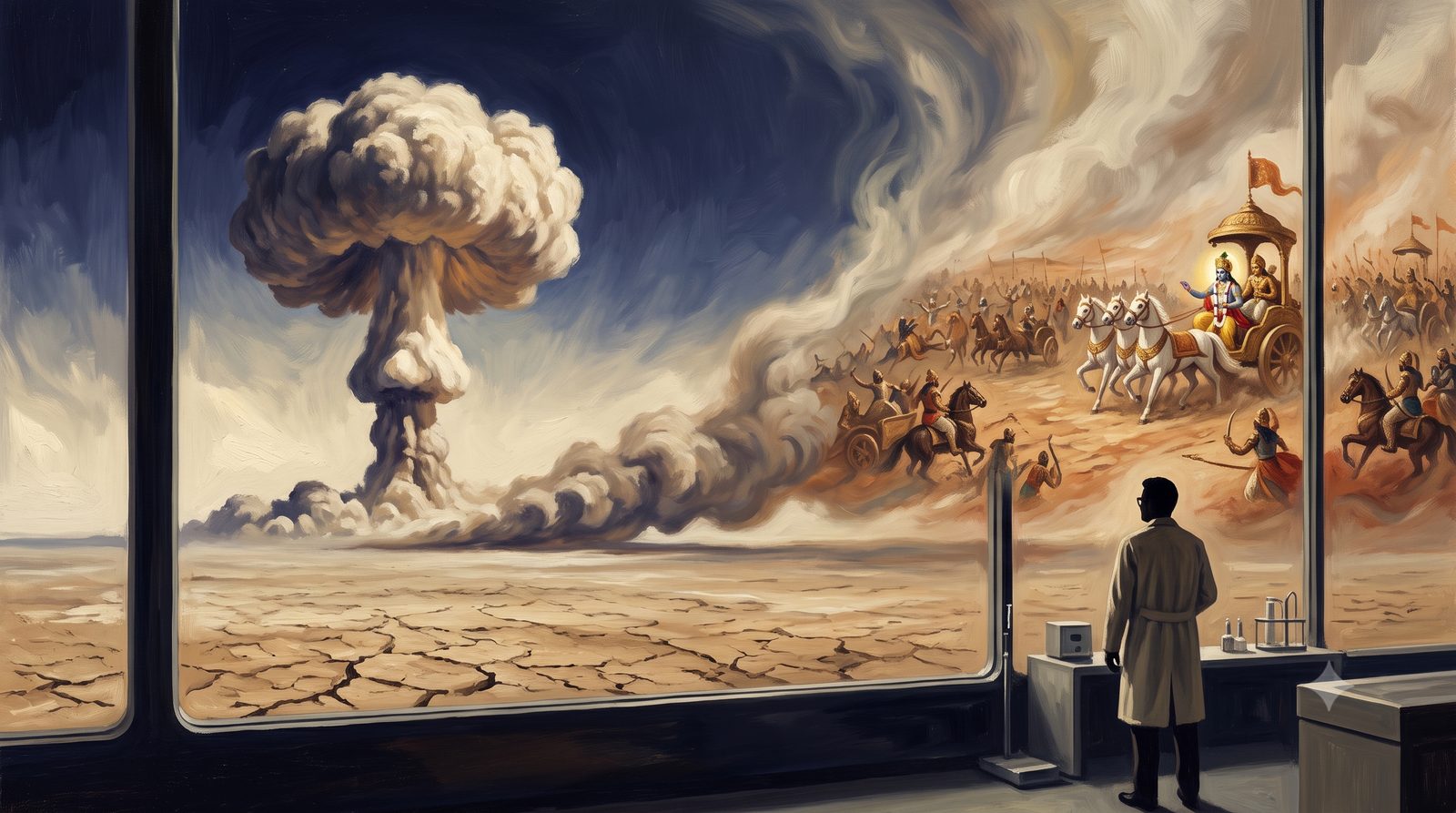
The line everyone knows
In a television interview filmed twenty years after the Trinity test, a visibly exhausted J. Robert Oppenheimer described the moment the first atomic bomb detonated in the New Mexico desert. He said a line from the Hindu scripture came into his head: I am become death, the destroyer of worlds.
It is a magnificent piece of television. It is also, as translation goes, a bit of a liberty.
The verse is Bhagavad Gita 11.32. The Sanskrit begins kālo'smi.
Kāla does not mean death. It means time.
Time, not death
A more literal rendering runs something like: I am time, grown mature, come here to draw the worlds to their end.
Now, Oppenheimer was not being careless. He had studied Sanskrit at Berkeley in the 1930s under Arthur Ryder and read the Gita in the original — this was not a man working from a paperback. And kāla does carry death among its meanings, because time is what kills everything eventually. The two ideas sit inside the same word.
But the shift matters. Death is an event. Time is a condition. Death is something that arrives; time is something you have been inside all along.
There is also that odd construction, I am become — archaic even in 1945, borrowed from the register of the King James Bible. It makes the line sound like scripture in English, which is presumably the point, and it makes it sound like a transformation. Something that has happened to the speaker. The Sanskrit is flatter and stranger: I am time. Present tense. Always was.
Death is an event. Time is a condition. Only one of those can be your fault.
The context makes it much worse
Here is the part almost nobody quotes, and it changes the whole thing.
In chapter eleven, Arjuna asks to see Krishna's true form. Krishna grants it, and the vision is not comforting — it is a mouth full of worlds, all of time visible at once, warriors from both armies rushing into it and being destroyed.
Arjuna, understandably, asks who this is.
The famous line is the answer. And crucially, Krishna keeps going. He tells Arjuna that the warriors arrayed against him are already dead — that time has already done this, the outcome is already the case, and Arjuna's role is merely to be the instrument through which it becomes visible.
The verse is not a boast about power. It is a statement about how little the person holding the weapon actually decides.
Which means the most famous line ever quoted by the man who built the atomic bomb is, in its original setting, an argument that the person doing the deed is not the one who chose it.
Did he even say it at the time?
Probably not out loud.
The 1965 interview is the only source for the line, given two decades after the fact by a man who had spent those decades thinking very hard about what he had done. He says it came into his mind — a memory of a thought, recalled long afterwards.
His brother Frank was at Trinity too. Asked what Robert said when it went off, Frank's recollection was considerably shorter. He remembered: it worked.
Both things are probably true. People rarely produce their best line in the moment. They produce it later, in the long quiet afterwards, when they are trying to explain to themselves what they were part of.
Why this verse and not another
Of the 700 verses in the Gita, this is the one that broke through into Western culture, and it is worth asking why.
It is not representative. The Gita is overwhelmingly a book about how to act well when your options are bad, addressed to someone who does not want to fight. Chapter eleven is the strangest, most cosmic passage in the whole text — the one moment where the conversation stops being practical and becomes overwhelming.
But it was the one a physicist reached for, and so it became the one everyone knows. Most people who can quote it have never read the argument it interrupts.
Which is a pity, because the rest of the book is far more useful. Krishna spends most of the Gita telling a man who is paralysed by the consequences of his actions how to act anyway. That advice was probably more relevant to Los Alamos than the terrifying vision in the middle of it.
Oppenheimer quoted Gita 11.32 as "I am become death." The Sanskrit says time, not death — and in context the verse is not about power at all, but about how little the person holding the weapon gets to decide.