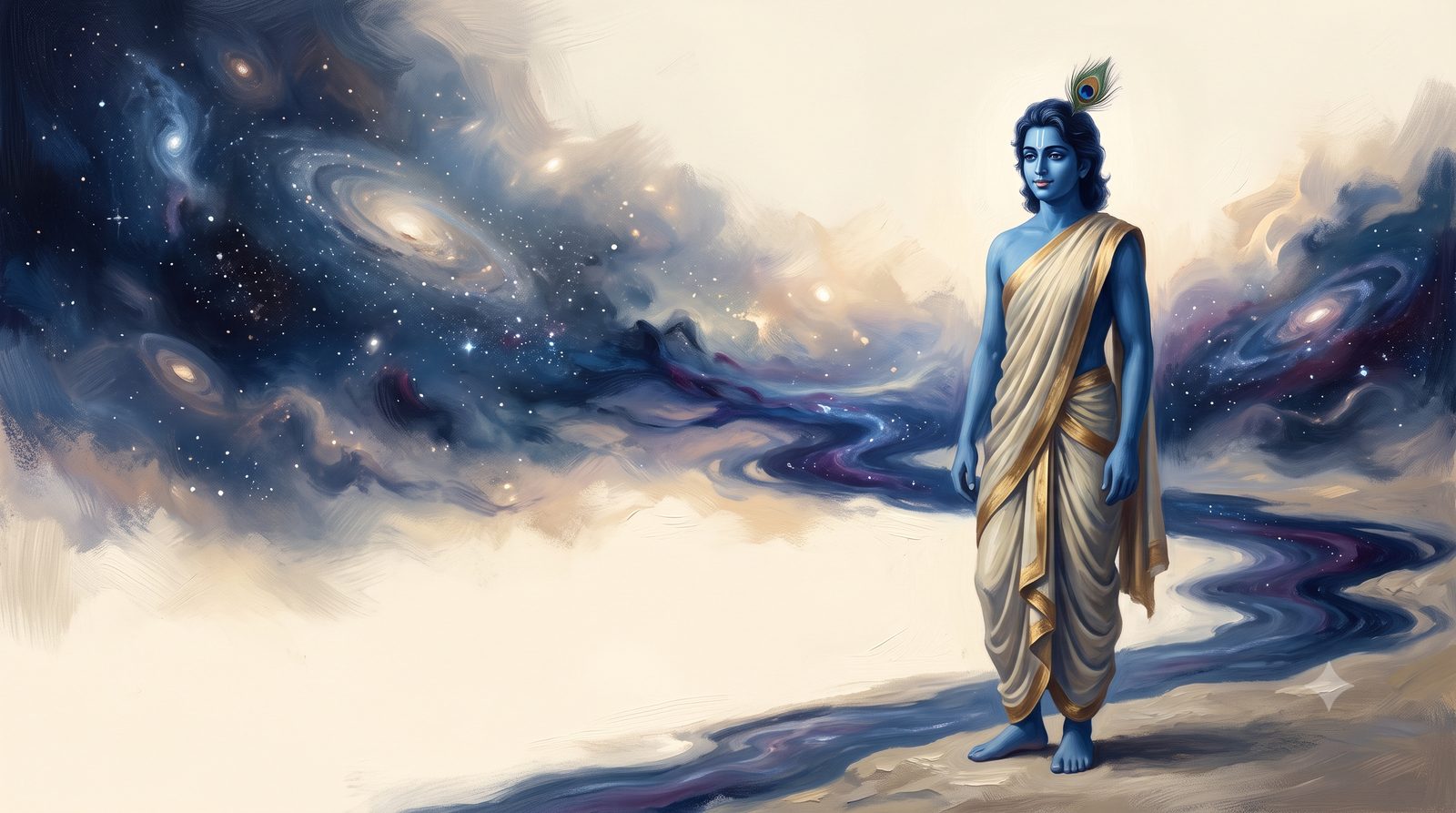
The disappointing answer first
His name means dark.
That is not a metaphor or an interpretation. Kṛṣṇa is an ordinary Sanskrit adjective meaning black or dark. The texts describe him as shyama — dark, dusky, the colour of a rain cloud before it breaks.
So the textual Krishna is not blue. He is dark-skinned, strikingly so, and it is noted often enough that it is clearly meant to be part of how you picture him.
Blue is a painter's decision, not a scriptural one. And it stuck so thoroughly that it has effectively replaced the original.
The poison story
The version most people are told involves Putana, a demoness sent by Kamsa to kill the infant Krishna. She smeared poison on her breast and offered to nurse him.
Krishna drank, and kept drinking, and took her life along with the milk. In the popular retelling, the poison turned his skin blue and stayed that way.
It is a good story and it is doing something quite specific: explaining a visual convention that already existed by the time anyone needed to explain it. The blue came first; the poison arrived afterwards to account for it.
This happens constantly in living traditions and it is not a criticism. It is just worth knowing which direction the explanation is travelling.
The one that actually holds up
The better answer is about what blue is used for.
Look at what is blue in the world as an ancient painter would have experienced it: the sky and the ocean. Both are enormous, both have no edge you can locate, and neither is really blue when you get close to it. Scoop up seawater and it is clear. Blue is what vastness looks like at a distance.
So blue becomes the working colour for the boundless. It is used for Vishnu, for Rama, for Krishna — figures whose whole theological point is that they exceed the shape they are appearing in.
There is a practical dimension too. Painting a figure blue tells you instantly that you are not looking at a human being. In a crowded mural where everyone is wearing similar clothes, colour does the work that a halo does in European painting.
And there is a neat rhyme with the original word. Shyama is the colour of a monsoon cloud — dark, but read against a bright sky it reads blue-black. The dark Krishna and the blue Krishna may be the same observation, made by a poet and then by a painter.
Blue is what vastness looks like from far enough away. Scoop it up and it is clear.
Why it matters slightly more than it seems
There is a live conversation in India about this, because the shift from dark to blue is not neutral. Skin colour carries a great deal of freight, and a tradition that repeatedly and admiringly describes its most beloved figure as dark, whose art then renders him a colour no human being is, is doing something worth noticing.
You do not have to resolve that to enjoy the pictures. But it is a useful thing to have in your head, because it is a small demonstration of how these texts actually work.
The Gita is roughly two thousand years old and has been continuously read, argued over, retranslated and repainted ever since. Nothing about it arrives to you unmediated. Every version you meet has been handled.
Which is not a reason for suspicion. It is a reason to read the thing itself, closely, and notice where your picture came from.
The texts call Krishna dark, not blue — his name literally means dark. Blue is an artistic convention for the boundless, and it worked so well it replaced the original.