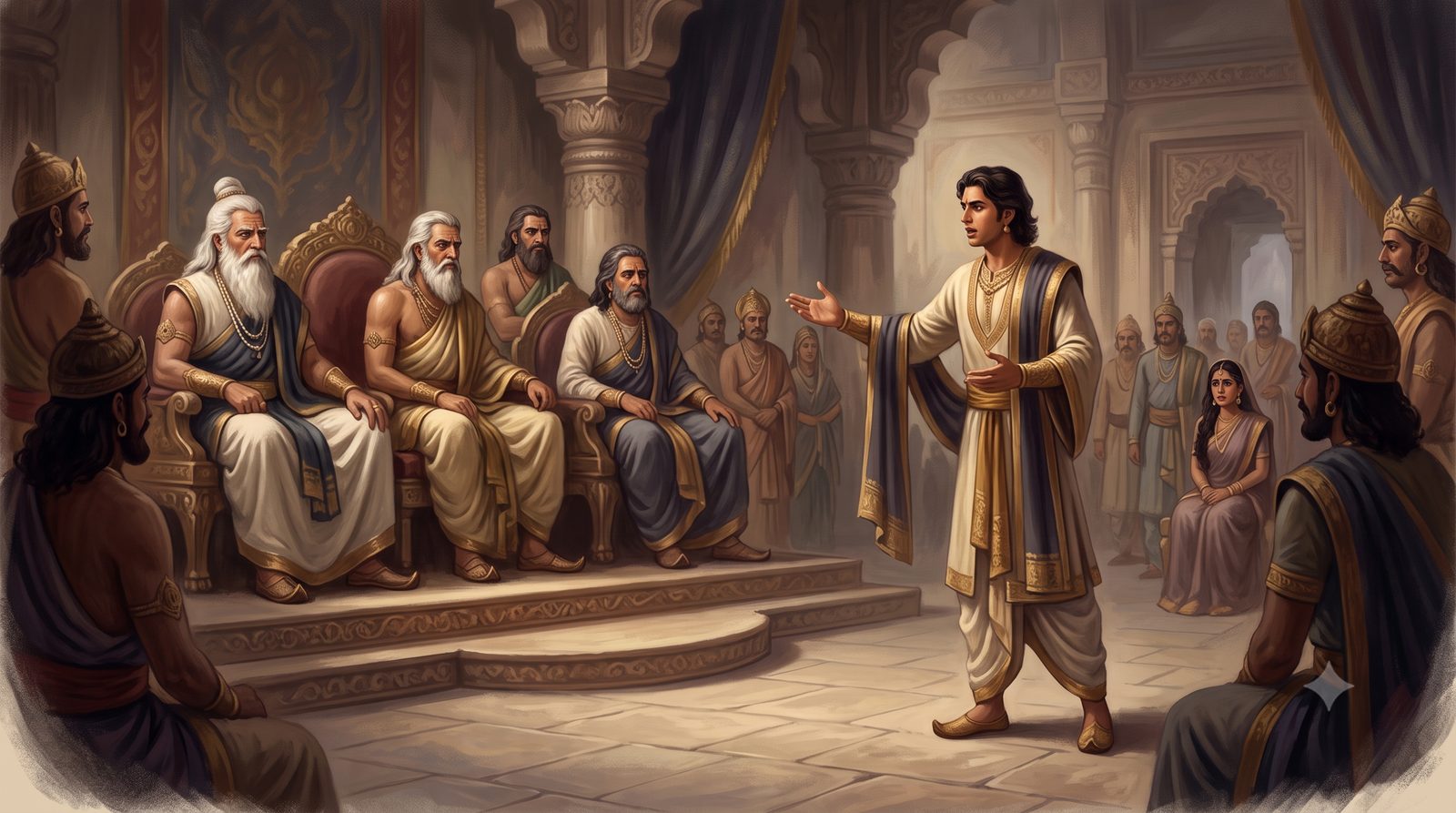
The room
Yudhishthira has lost the dice game comprehensively — kingdom, brothers, himself — and has then staked and lost Draupadi. She is dragged into the assembly hall.
Consider who is sitting in that room. Bhishma, the patriarch, unmatched in reputation. Drona, the greatest teacher of the age. Kripa. Vidura. Dhritarashtra on the throne. A hall full of kings and elders, every one of them a man of standing.
Draupadi asks her question, and it is a good one, precise and legal: Yudhishthira staked himself first and lost. A man who is no longer free owns nothing. By what right did he then stake her?
The hall goes quiet.
Bhishma's answer, when it comes, is that the matter of what a man may stake is subtle and he cannot determine it. That is the finest man of his generation, in the room, saying the question is complicated.
Drona says nothing. Kripa says nothing. The king says nothing.
One man stands up
Vikarna was one of Duryodhana's hundred brothers. He is barely characterised anywhere else in the epic. He has no famous weapon, no boon, no curse, no divine parentage.
He stood up and said that nobody was answering the woman's question, so he would.
His argument was straightforward. Yudhishthira did not stake Draupadi of his own initiative — he was invited to by the opposing side. He had already lost himself and had nothing left to stake. And Draupadi was not solely his to stake in any case, being the wife of all five. Therefore she was not lawfully won.
That is a younger brother, in his own family's hall, in front of his brother the effective ruler, telling the assembled greatest men of the age that they are wrong and a woman being assaulted in front of them is in the right.
Karna shut him down — told him he was a boy, that his elders had stayed silent for good reason, and that he should sit down. He sat down.
The disrobing proceeded.
The greatest man of his generation said the question was subtle. A boy nobody remembers said it was not.
And then he fought for the other side anyway
Here is the part that keeps the story from being tidy.
When the war came, Vikarna fought for Duryodhana. He knew his brother was in the wrong. He had said so, out loud, in public, at real personal cost. And he went to war on his side regardless, because he was a Kaurava and that was where Kauravas stood.
Which puts him in the same trap as Bhishma and Drona: a decent man bound to an indecent cause by an obligation he would not break.
The Gita, in other words, is a conversation about a problem that half the men on that field are already living inside.
Bhima remembers
Bhima had sworn to kill all hundred of Duryodhana's brothers, and he was thorough about it.
When he came to Vikarna, the epic pauses. Bhima tells him, in effect: I know who you are. I know what you said in that hall. You are the one I would have spared.
But the vow covered all hundred, and Vikarna was standing in front of him with a weapon.
Bhima killed him and is described as grieving over the body — one of very few deaths in that war he is shown to regret.
That is the whole of Vikarna's story. He spoke once when it mattered, was told to sit down, fought for the side he had condemned, and was killed by a man who admired him for the thing everyone else in the room had failed to do.
Why he is worth ten seconds of Chapter 1
When Duryodhana runs through his warriors in Verse 8, Vikarna is in the middle of the list. No emphasis. Just a name between Ashwatthama and the son of Somadatta.
But he is the counter-argument sitting inside the Gita's opening.
It is tempting to read the war as good against evil, or as an unfortunate collision of duties in which nobody could have done differently. Bhishma could not break his vow. Drona could not abandon his employer. Karna could not repay Duryodhana any other way.
Vikarna is the evidence that someone could, in fact, have spoken. It was possible. It was available to everyone in that hall. The cost was being told to sit down by Karna.
One person paid it.
In a hall containing Bhishma, Drona and Kripa, the only person who objected to Draupadi's treatment was a brother of Duryodhana's whom nobody remembers. He then fought and died for the side he had condemned.