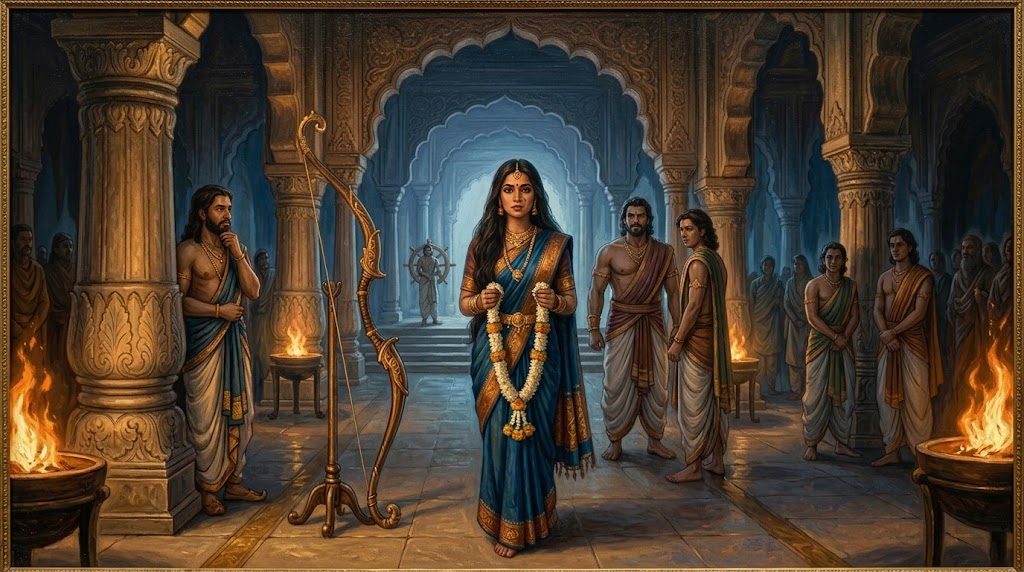
She was not born. She arrived.
Draupadi does not have a childhood, because she does not have an infancy.
Her father, King Drupada, held a great sacrifice for a specific purpose: to obtain a son capable of killing Drona. Out of the fire came a young man, fully grown and armed — Dhrishtadyumna.
And then, unasked for, a young woman came out of the same fire.
She is called Yajnaseni, born of sacrifice. Also Panchali, of the Panchala kingdom. Also Krishnaa — the dark one, the feminine of Krishna.
It is worth registering how strange this is even by the epic's standards. She has no mother, no birth, no growing up. She steps out of a ritual fire already adult, into a story that was not asking for her, and proceeds to become its most consequential figure.
The fish, the eye, the archer
Drupada arranged a swayamvara with a test: a fish mounted on a rotating wheel high above, a pool of water beneath, and a bow. The suitor had to look only at the reflection in the water and hit the fish's eye.
Kings queued up and failed. Karna, by most accounts, could have done it and was refused permission to try on account of his birth — a scene that does more to explain Karna than anything else in the epic.
The Pandavas were in exile at the time and attending disguised as brahmins. Arjuna, dressed as a poor priest, took the bow and hit the eye.
So the answer to who won Draupadi is: Arjuna. Singular. That is the part people forget.
And then the sentence
The brothers went home to the potter's hut where they were staying. Someone called out to Kunti from the doorway that they had brought back alms.
Kunti, occupied and not turning around, gave the answer she had given a hundred times: share it equally among yourselves.
Then she looked.
This is the version everyone knows, and it is in the text. But the epic does not actually treat a slip of the tongue as sufficient. What follows is a long argument in which Drupada objects strenuously, Yudhishthira insists a mother's word cannot be undone, and the sage Vyasa is eventually called in to settle it.
Vyasa's ruling is that this was always going to happen. He describes a previous life in which Draupadi asked Shiva for a husband — repeatedly, five times over, listing a different virtue each time — and was granted exactly what she asked for, distributed across five men.
One woman asked five times for the perfect husband. She was taken at her word.
The reason nobody says out loud
Strip out the divine machinery and look at what the marriage does.
Five brothers. One kingdom to inherit. One extraordinary woman, daughter of a powerful king whose army they need.
If Arjuna alone marries Draupadi, the Panchala alliance attaches to Arjuna. The other four have their own claims and their own resentments, and the most reliable way to fracture a set of brothers is to give one of them a queen and a father-in-law with troops.
The shared marriage makes the alliance indivisible. Drupada's army is committed to all five or none. It removes, at a stroke, the exact fault line that destroyed the previous generation of that family.
None of this is stated. It does not need to be. Everyone in the room can do the arithmetic.
There is also a rule they set up, which tells you they were thinking clearly: Draupadi would spend a year with each brother in turn, and any brother who intruded on another's year would take a twelve-year exile. Arjuna breaks it, knowingly, to retrieve a cow for a brahmin, and serves the full term without argument.
Why she matters to Chapter 1
In the Gita's opening verses, Sanjaya names the sons of Draupadi twice among the Pandava warriors — five young men, one from each father, all of them on that field.
Every one of them dies. Not in battle. Ashwatthama kills them in their sleep during a night raid after the war is effectively decided, mistaking them for their fathers.
So Draupadi, who arrived out of a fire and was gambled away in an assembly hall and waited thirteen years for the war that would answer it, ends the story with the war won and all five sons dead.
When Arjuna looks across the battlefield and says he can see nothing good coming of this, he is not being sentimental. He turns out to be almost exactly right.
Arjuna won her. Kunti's careless sentence made her all five brothers' wife. And the arrangement, however it arose, made the Panchala alliance impossible to split — which is the thing the family's last generation failed to manage.